Geometry, Plane Geometry, Circles
This topic covers the properties of circles, including radius, diameter, circumference, area, chords, tangents, secants, arcs, and sectors. Questions involve calculations related to these elements and understanding theorems about angles and segments in circles.
Tangent to a Circle-
Inscribed Circle in a Triangle
Inside a triangle there is a point P, whose distances from the lines containing the sides of the triangle are `d_a,d_b,d_c`. Let R denote the radius of the circumscribed circle of the triangle and r the radius of the inscribed circle in the triangle. Show that `sqrt(d_a)+sqrt(d_b)+sqrt(d_3)<= sqrt (2R+5r) `.
Sources:Topics:Geometry -> Plane Geometry -> Triangles Geometry -> Plane Geometry -> Circles Algebra -> Inequalities- Gillis Mathematical Olympiad, 2019-2020 Question 7
-
Sets in the Plane
A. Does there exist a set A in the plane such that its intersection with every circle contains exactly two points?
B. Does there exist a set B in the plane such that its intersection with every circle of radius 1 contains exactly two points?
Sources:Topics:Geometry -> Plane Geometry -> Circles Proof and Example -> Constructing an Example / Counterexample Set Theory Proof and Example -> Proof by Contradiction Minimum and Maximum Problems / Optimization Problems- Grossman Math Olympiad, 2006 Question 3
-
How a Wheel Turns
All 6 wheels in the diagram rotate as they touch each other without slipping. The diameter of the leftmost wheel is 15.7 cm and it makes 12 revolutions per minute.
It is known that the smallest wheel makes one revolution per second.
What is the diameter of the smallest wheel?
Sources:
-
DEFECTIVE OBSERVATION
Our observation of little things is frequently defective, and our memories very liable to lapse. A certain judge recently remarked in a case that he had no recollection whatever of putting the wedding-ring on his wife's finger. Can you correctly answer these questions without having the coins in sight? On which side of a penny is the date given? Some people are so unobservant that, although they are handling the coin nearly every day of their lives, they are at a loss to answer this simple question. If I lay a penny flat on the table, how many other pennies can I place around it, every one also lying flat on the table, so that they all touch the first one? The geometrician will, of course, give the answer at once, and not need to make any experiment. He will also know that, since all circles are similar, the same answer will necessarily apply to any coin. The next question is a most interesting one to ask a company, each person writing down his answer on a slip of paper, so that no one shall be helped by the answers of others. What is the greatest number of three-penny-pieces that may be laid flat on the surface of a half-crown, so that no piece lies on another or overlaps the surface of the half-crown? It is amazing what a variety of different answers one gets to this question. Very few people will be found to give the correct number. Of course the answer must be given without looking at the coins. Sources:- Amusements in Mathematics, Henry Ernest Dudeney Question 28
-
THE SPOT ON THE TABLE
A boy, recently home from school, wished to give his father an exhibition of his precocity. He pushed a large circular table into the corner of the room, as shown in the illustration, so that it touched both walls, and he then pointed to a spot of ink on the extreme edge.
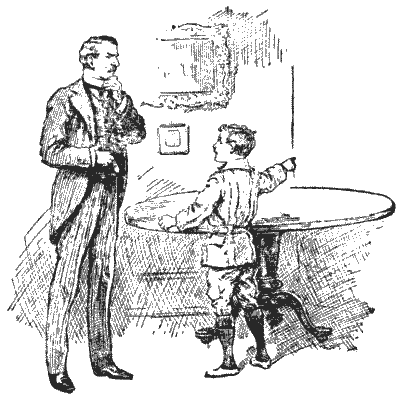
"Here is a little puzzle for you, pater," said the youth. "That spot is exactly eight inches from one wall and nine inches from the other. Can you tell me the diameter of the table without measuring it?"
The boy was overheard to tell a friend, "It fairly beat the guv'nor;" but his father is known to have remarked to a City acquaintance that he solved the thing in his head in a minute. I often wonder which spoke the truth.
Sources:Topics:Geometry -> Plane Geometry -> Circles Algebra -> Equations Algebra -> Word Problems Geometry -> Plane Geometry -> Pythagorean Theorem- Amusements in Mathematics, Henry Ernest Dudeney Question 97
-
THE BUN PUZZLE
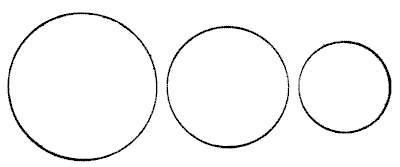 The three circles represent three buns, and it is simply required to show how these may be equally divided among four boys. The buns must be regarded as of equal thickness throughout and of equal thickness to each other. Of course, they must be cut into as few pieces as possible. To simplify it I will state the rather surprising fact that only five pieces are necessary, from which it will be seen that one boy gets his share in two pieces and the other three receive theirs in a single piece. I am aware that this statement "gives away" the puzzle, but it should not destroy its interest to those who like to discover the "reason why."
Sources:Topics:Geometry -> Area Calculation Geometry -> Plane Geometry -> Circles Geometry -> Plane Geometry -> Pythagorean Theorem Combinatorics -> Combinatorial Geometry -> Cut a Shape / Dissection Problems
The three circles represent three buns, and it is simply required to show how these may be equally divided among four boys. The buns must be regarded as of equal thickness throughout and of equal thickness to each other. Of course, they must be cut into as few pieces as possible. To simplify it I will state the rather surprising fact that only five pieces are necessary, from which it will be seen that one boy gets his share in two pieces and the other three receive theirs in a single piece. I am aware that this statement "gives away" the puzzle, but it should not destroy its interest to those who like to discover the "reason why."
Sources:Topics:Geometry -> Area Calculation Geometry -> Plane Geometry -> Circles Geometry -> Plane Geometry -> Pythagorean Theorem Combinatorics -> Combinatorial Geometry -> Cut a Shape / Dissection Problems- Amusements in Mathematics, Henry Ernest Dudeney Question 148
-
THE GREAT MONAD
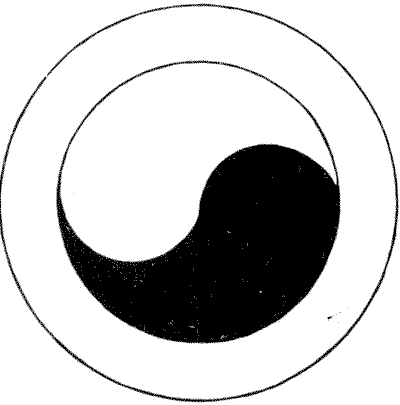
Here is a symbol of tremendous antiquity which is worthy of notice. It is borne on the Korean ensign and merchant flag, and has been adopted as a trade sign by the Northern Pacific Railroad Company, though probably few are aware that it is the Great Monad, as shown in the sketch below. This sign is to the Chinaman what the cross is to the Christian. It is the sign of Deity and eternity, while the two parts into which the circle is divided are called the Yin and the Yan—the male and female forces of nature. A writer on the subject more than three thousand years ago is reported to have said in reference to it: "The illimitable produces the great extreme. The great extreme produces the two principles. The two principles produce the four quarters, and from the four quarters we develop the quadrature of the eight diagrams of Feuh-hi." I hope readers will not ask me to explain this, for I have not the slightest idea what it means. Yet I am persuaded that for ages the symbol has had occult and probably mathematical meanings for the esoteric student.
I will introduce the Monad in its elementary form. Here are three easy questions respecting this great symbol:—
(I.) Which has the greater area, the inner circle containing the Yin and the Yan, or the outer ring?
(II.) Divide the Yin and the Yan into four pieces of the same size and shape by one cut.
(III.) Divide the Yin and the Yan into four pieces of the same size, but different shape, by one straight cut.
Sources:Topics:Geometry -> Area Calculation Geometry -> Plane Geometry -> Circles Combinatorics -> Combinatorial Geometry -> Cut a Shape / Dissection Problems- Amusements in Mathematics, Henry Ernest Dudeney Question 158
-
THE TWO HORSESHOES
Why horseshoes should be considered "lucky" is one of those things which no man can understand. It is a very old superstition, and John Aubrey (`1626-1700`) says, "Most houses at the West End of London have a horseshoe on the threshold." In Monmouth Street there were seventeen in `1813` and seven so late as `1855`. Even Lord Nelson had one nailed to the mast of the ship Victory. To-day we find it more conducive to "good luck" to see that they are securely nailed on the feet of the horse we are about to drive.
Nevertheless, so far as the horseshoe, like the Swastika and other emblems that I have had occasion at times to deal with, has served to symbolize health, prosperity, and goodwill towards men, we may well treat it with a certain amount of respectful interest. May there not, moreover, be some esoteric or lost mathematical mystery concealed in the form of a horseshoe? I have been looking into this matter, and I wish to draw my readers' attention to the very remarkable fact that the pair of horseshoes shown in my illustration are related in a striking and beautiful manner to the circle, which is the symbol of eternity. I present this fact in the form of a simple problem, so that it may be seen how subtly this relation has been concealed for ages and ages. My readers will, I know, be pleased when they find the key to the mystery.
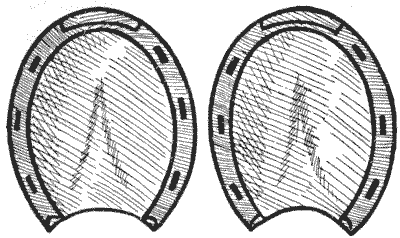
Cut out the two horseshoes carefully round the outline and then cut them into four pieces, all different in shape, that will fit together and form a perfect circle. Each shoe must be cut into two pieces and all the part of the horse's hoof contained within the outline is to be used and regarded as part of the area.
Sources:Topics:Geometry -> Plane Geometry -> Circles Combinatorics -> Combinatorial Geometry -> Cut a Shape / Dissection Problems- Amusements in Mathematics, Henry Ernest Dudeney Question 160
-
THE WIZARD'S CATS
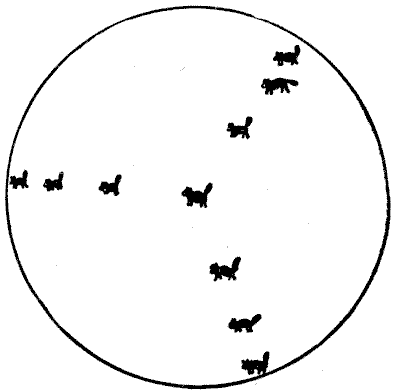 A wizard placed ten cats inside a magic circle as shown in our illustration, and hypnotized them so that they should remain stationary during his pleasure. He then proposed to draw three circles inside the large one, so that no cat could approach another cat without crossing a magic circle. Try to draw the three circles so that every cat has its own enclosure and cannot reach another cat without crossing a line.
Sources:
A wizard placed ten cats inside a magic circle as shown in our illustration, and hypnotized them so that they should remain stationary during his pleasure. He then proposed to draw three circles inside the large one, so that no cat could approach another cat without crossing a magic circle. Try to draw the three circles so that every cat has its own enclosure and cannot reach another cat without crossing a line.
Sources:
- Amusements in Mathematics, Henry Ernest Dudeney Question 167
-
THE GARDEN PUZZLE
Professor Rackbrain tells me that he was recently smoking a friendly pipe under a tree in the garden of a country acquaintance. The garden was enclosed by four straight walls, and his friend informed him that he had measured these and found the lengths to be `80, 45, 100`, and `63` yards respectively. "Then," said the professor, "we can calculate the exact area of the garden." "Impossible," his host replied, "because you can get an infinite number of different shapes with those four sides." "But you forget," Rackbrane said, with a twinkle in his eye, "that you told me once you had planted this tree equidistant from all the four corners of the garden." Can you work out the garden's area?Sources:Topics:Geometry -> Area Calculation Geometry -> Plane Geometry -> Circles Algebra -> Equations Algebra -> Word Problems- Amusements in Mathematics, Henry Ernest Dudeney Question 182