Amusements in Mathematics, Henry Ernest Dudeney
-
Question 271 - FIFTEEN LETTER PUZZLE
ALE FOE HOD BGN CAB HEN JOG KFM HAG GEM MOB BFH FAN KIN JEK DFL JAM HIM GCL LJH AID JIB FCJ NJD OAK FIG HCK MLN BED OIL MCD BLK ICE CON DGK The above is the solution of a puzzle I gave in Tit-bits in the summer of `1896`. It was required to take the letters, A, B, C, D, E, F, G, H, I, J, K, L, M, N, and O, and with them form thirty-five groups of three letters so that the combinations should include the greatest number possible of common English words. No two letters may appear together in a group more than once. Thus, A and L having been together in ALE, must never be found together again; nor may A appear again in a group with E, nor L with E. These conditions will be found complied with in the above solution, and the number of words formed is twenty-one. Many persons have since tried hard to beat this number, but so far have not succeeded.
More than thirty-five combinations of the fifteen letters cannot be formed within the conditions. Theoretically, there cannot possibly be more than twenty-three words formed, because only this number of combinations is possible with a vowel or vowels in each. And as no English word can be formed from three of the given vowels (A, E, I, and O), we must reduce the number of possible words to twenty-two. This is correct theoretically, but practically that twenty-second word cannot be got in. If JEK, shown above, were a word it would be all right; but it is not, and no amount of juggling with the other letters has resulted in a better answer than the one shown. I should, say that proper nouns and abbreviations, such as Joe, Jim, Alf, Hal, Flo, Ike, etc., are disallowed.
Now, the present puzzle is a variation of the above. It is simply this: Instead of using the fifteen letters given, the reader is allowed to select any fifteen different letters of the alphabet that he may prefer. Then construct thirty-five groups in accordance with the conditions, and show as many good English words as possible.
Topics:Combinatorics -
Question 272 - THE NINE SCHOOLBOYS
This is a new and interesting companion puzzle to the "Fifteen Schoolgirls" (see solution of No. `269`), and even in the simplest possible form in which I present it there are unquestionable difficulties. Nine schoolboys walk out in triplets on the six week days so that no boy ever walks side by side with any other boy more than once. How would you arrange them?
If we represent them by the first nine letters of the alphabet, they might be grouped on the first day as follows:—
A B C D E F G H I Then A can never walk again side by side with B, or B with C, or D with E, and so on. But A can, of course, walk side by side with C. It is here not a question of being together in the same triplet, but of walking side by side in a triplet. Under these conditions they can walk out on six days; under the "Schoolgirls" conditions they can only walk on four days.
Topics:Combinatorics -
Question 273 - THE ROUND TABLE
Seat the same n persons at a round table on
`((n-1)(n-2))/2`
occasions so that no person shall ever have the same two neighbours twice. This is, of course, equivalent to saying that every person must sit once, and once only, between every possible pair.
Topics:Combinatorics -
Question 274 - THE MOUSE-TRAP PUZZLE
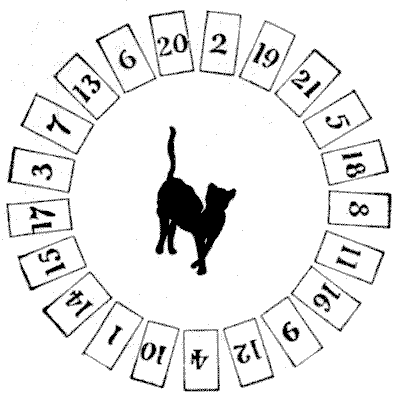 This is a modern version, with a difference, of an old puzzle of the same name. Number twenty-one cards, `1, 2, 3`, etc., up to `21`, and place them in a circle in the particular order shown in the illustration. These cards represent mice. You start from any card, calling that card "one," and count, "one, two, three," etc., in a clockwise direction, and when your count agrees with the number on the card, you have made a "catch," and you remove the card. Then start at the next card, calling that "one," and try again to make another "catch." And so on. Supposing you start at `18`, calling that card "one," your first "catch" will be `19`. Remove `19` and your next "catch" is `10`. Remove `10` and your next "catch" is `1`. Remove the `1`, and if you count up to `21` (you must never go beyond), you cannot make another "catch." Now, the ideal is to "catch" all the twenty-one mice, but this is not here possible, and if it were it would merely require twenty-one different trials, at the most, to succeed. But the reader may make any two cards change places before he begins. Thus, you can change the `6` with the `2`, or the `7` with the `11`, or any other pair. This can be done in several ways so as to enable you to "catch" all the twenty-one mice, if you then start at the right place. You may never pass over a "catch"; you must always remove the card and start afresh.
-
Question 275 - THE SIXTEEN SHEEP
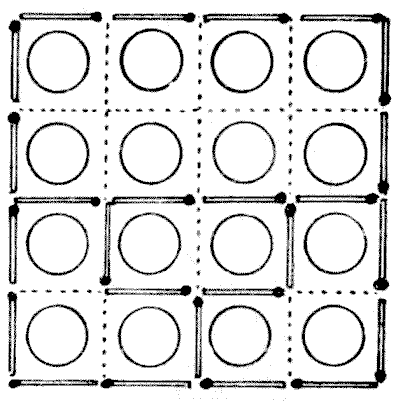 Here is a new puzzle with matches and counters or coins. In the illustration the matches represent hurdles and the counters sheep. The sixteen hurdles on the outside, and the sheep, must be regarded as immovable; the puzzle has to do entirely with the nine hurdles on the inside. It will be seen that at present these nine hurdles enclose four groups of `8, 3, 3`, and `2` sheep. The farmer requires to readjust some of the hurdles so as to enclose `6, 6`, and `4` sheep. Can you do it by only replacing two hurdles? When you have succeeded, then try to do it by replacing three hurdles; then four, five, six, and seven in succession. Of course, the hurdles must be legitimately laid on the dotted lines, and no such tricks are allowed as leaving unconnected ends of hurdles, or two hurdles placed side by side, or merely making hurdles change places. In fact, the conditions are so simple that any farm labourer will understand it directly.
Topics:Puzzles and Rebuses -> Matchstick Puzzles
Here is a new puzzle with matches and counters or coins. In the illustration the matches represent hurdles and the counters sheep. The sixteen hurdles on the outside, and the sheep, must be regarded as immovable; the puzzle has to do entirely with the nine hurdles on the inside. It will be seen that at present these nine hurdles enclose four groups of `8, 3, 3`, and `2` sheep. The farmer requires to readjust some of the hurdles so as to enclose `6, 6`, and `4` sheep. Can you do it by only replacing two hurdles? When you have succeeded, then try to do it by replacing three hurdles; then four, five, six, and seven in succession. Of course, the hurdles must be legitimately laid on the dotted lines, and no such tricks are allowed as leaving unconnected ends of hurdles, or two hurdles placed side by side, or merely making hurdles change places. In fact, the conditions are so simple that any farm labourer will understand it directly.
Topics:Puzzles and Rebuses -> Matchstick Puzzles -
Question 276 - THE EIGHT VILLAS
In one of the outlying suburbs of London a man had a square plot of ground on which he decided to build eight villas, as shown in the illustration, with a common recreation ground in the middle. After the houses were completed, and all or some of them let, he discovered that the number of occupants in the three houses forming a side of the square was in every case nine. He did not state how the occupants were distributed, but I have shown by the numbers on the sides of the houses one way in which it might have happened. The puzzle is to discover the total number of ways in which all or any of the houses might be occupied, so that there should be nine persons on each side. In order that there may be no misunderstanding, I will explain that although B is what we call a reflection of A, these would count as two different arrangements, while C, if it is turned round, will give four arrangements; and if turned round in front of a mirror, four other arrangements. All eight must be counted.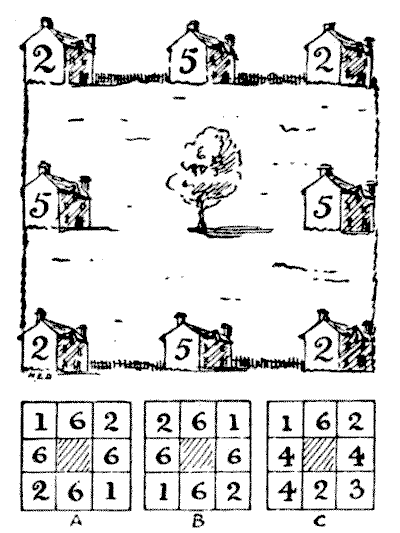
-
Question 277 - COUNTER CROSSES
All that we need for this puzzle is nine counters, numbered `1, 2, 3, 4, 5, 6, 7, 8`, and `9`. It will be seen that in the illustration A these are arranged so as to form a Greek cross, while in the case of B they form a Latin cross. In both cases the reader will find that the sum of the numbers in the upright of the cross is the same as the sum of the numbers in the horizontal arm. It is quite easy to hit on such an arrangement by trial, but the problem is to discover in exactly how many different ways it may be done in each case. Remember that reversals and reflections do not count as different. That is to say, if you turn this page round you get four arrangements of the Greek cross, and if you turn it round again in front of a mirror you will get four more. But these eight are all regarded as one and the same. Now, how many different ways are there in each case?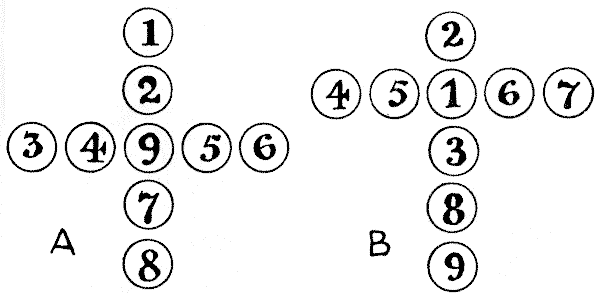
-
Question 278 - A DORMITORY PUZZLE
In a certain convent there were eight large dormitories on one floor, approached by a spiral staircase in the centre, as shown in our plan. On an inspection one Monday by the abbess it was found that the south aspect was so much preferred that six times as many nuns slept on the south side as on each of the other three sides. She objected to this overcrowding, and ordered that it should be reduced. On Tuesday she found that five times as many slept on the south side as on each of the other sides. Again she complained. On Wednesday she found four times as many on the south side, on Thursday three times as many, and on Friday twice as many. Urging the nuns to further efforts, she was pleased to find on Saturday that an equal number slept on each of the four sides of the house. What is the smallest number of nuns there could have been, and how might they have arranged themselves on each of the six nights? No room may ever be unoccupied.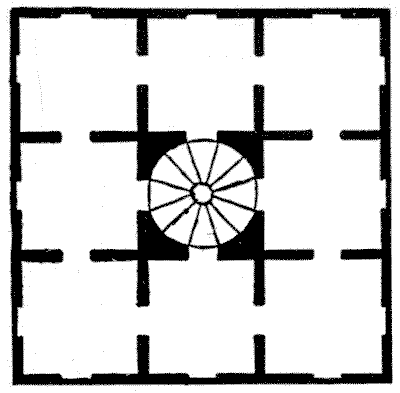
-
Question 279 - THE BARRELS OF BALSAM
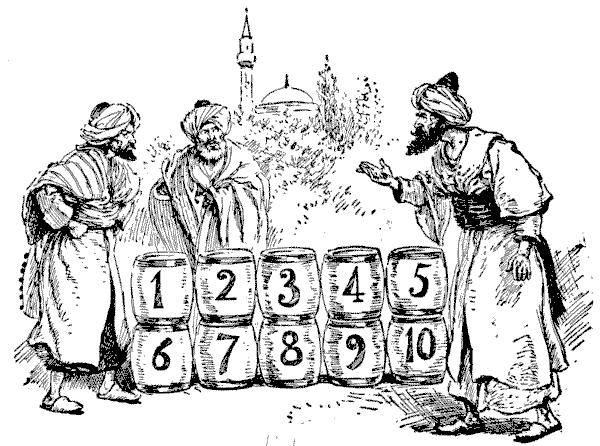
A merchant of Bagdad had ten barrels of precious balsam for sale. They were numbered, and were arranged in two rows, one on top of the other, as shown in the picture. The smaller the number on the barrel, the greater was its value. So that the best quality was numbered "`1`" and the worst numbered "`10`," and all the other numbers of graduating values. Now, the rule of Ahmed Assan, the merchant, was that he never put a barrel either beneath or to the right of one of less value. The arrangement shown is, of course, the simplest way of complying with this condition. But there are many other ways—such, for example, as this:—
1 2 5 7 8 3 4 6 9 10 Here, again, no barrel has a smaller number than itself on its right or beneath it. The puzzle is to discover in how many different ways the merchant of Bagdad might have arranged his barrels in the two rows without breaking his rule. Can you count the number of ways?
Topics:Combinatorics -
Question 280 - BUILDING THE TETRAHEDRON
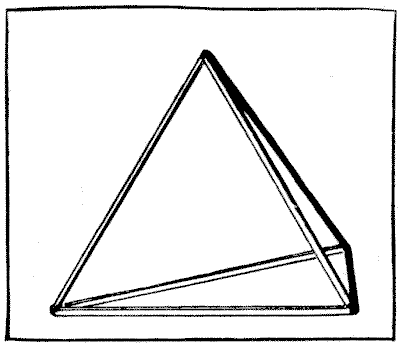
I possess a tetrahedron, or triangular pyramid, formed of six sticks glued together, as shown in the illustration. Can you count correctly the number of different ways in which these six sticks might have been stuck together so as to form the pyramid?
Some friends worked at it together one evening, each person providing himself with six lucifer matches to aid his thoughts; but it was found that no two results were the same. You see, if we remove one of the sticks and turn it round the other way, that will be a different pyramid. If we make two of the sticks change places the result will again be different. But remember that every pyramid may be made to stand on either of its four sides without being a different one. How many ways are there altogether?