Puzzles and Rebuses
This is a general category for brain-teasers that require cleverness, lateral thinking, or pattern recognition. Rebuses are word puzzles using pictures, symbols, or letters to represent words or phrases. Math-related versions might involve numerical or operational clues hidden in a visual format.
Matchstick Puzzles Reconstruct the Exercise / Cryptarithmetic-
THE SIXTEEN SHEEP
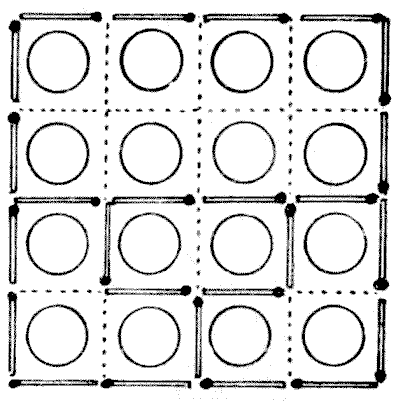 Here is a new puzzle with matches and counters or coins. In the illustration the matches represent hurdles and the counters sheep. The sixteen hurdles on the outside, and the sheep, must be regarded as immovable; the puzzle has to do entirely with the nine hurdles on the inside. It will be seen that at present these nine hurdles enclose four groups of `8, 3, 3`, and `2` sheep. The farmer requires to readjust some of the hurdles so as to enclose `6, 6`, and `4` sheep. Can you do it by only replacing two hurdles? When you have succeeded, then try to do it by replacing three hurdles; then four, five, six, and seven in succession. Of course, the hurdles must be legitimately laid on the dotted lines, and no such tricks are allowed as leaving unconnected ends of hurdles, or two hurdles placed side by side, or merely making hurdles change places. In fact, the conditions are so simple that any farm labourer will understand it directly.
Sources:Topics:Puzzles and Rebuses -> Matchstick Puzzles
Here is a new puzzle with matches and counters or coins. In the illustration the matches represent hurdles and the counters sheep. The sixteen hurdles on the outside, and the sheep, must be regarded as immovable; the puzzle has to do entirely with the nine hurdles on the inside. It will be seen that at present these nine hurdles enclose four groups of `8, 3, 3`, and `2` sheep. The farmer requires to readjust some of the hurdles so as to enclose `6, 6`, and `4` sheep. Can you do it by only replacing two hurdles? When you have succeeded, then try to do it by replacing three hurdles; then four, five, six, and seven in succession. Of course, the hurdles must be legitimately laid on the dotted lines, and no such tricks are allowed as leaving unconnected ends of hurdles, or two hurdles placed side by side, or merely making hurdles change places. In fact, the conditions are so simple that any farm labourer will understand it directly.
Sources:Topics:Puzzles and Rebuses -> Matchstick Puzzles- Amusements in Mathematics, Henry Ernest Dudeney Question 275
-
A mistake in the exercise
Prove that there is an error in the following multiplication problem:
\(\begin{array}& & & * & * & * & 2 & 7 \\ \times & & & & & * & * \\ \hline & * & * & * & * & * & 6 \\ + & * & * & * & * & * & \\ \hline & * & * & * & * & 4 & 6 \end{array}\)
Sources:Topics:Arithmetic Logic -> Reasoning / Logic Proof and Example -> Proof by Contradiction Number Theory -> Division Puzzles and Rebuses -> Reconstruct the Exercise / Cryptarithmetic- Beno Arbel Olympiad, 2013, Grade 7 Question 4
-
Question
In the following arithmetic puzzle, different digits have been replaced by different letters, and identical digits – by identical letters. Reconstruct the puzzle:
`BAOxxBAxxB=2002`
-
Reconstruct the Exercise
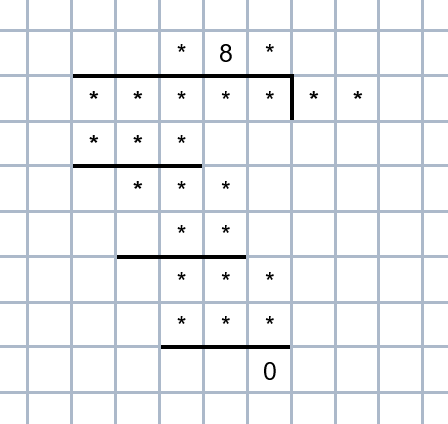
Reconstruct the digits in the following exercise:
-
Baobab
In the following exercise, identical digits have been replaced with identical letters, and different digits have been replaced with different letters. Reconstruct the exercise.
`BAOxxBAxxB = 2002`
Topics:Arithmetic Number Theory -> Modular Arithmetic / Remainder Arithmetic -> Divisibility Rules Logic -> Reasoning / Logic Number Theory -> Prime Numbers -> Prime Factorization Combinatorics -> Case Analysis / Checking Cases -> Processes / Procedures Puzzles and Rebuses -> Reconstruct the Exercise / Cryptarithmetic -
Letter Replacement
Each letter represents a different digit; whenever a specific letter appears, it is necessarily the same digit.
Find `B-E/2`
Given: `AB*C=DE`
And also `F^D=GF`
-
ABC
In the following exercise, different digits have been replaced with different letters, and identical digits have been replaced with identical digits. Find the three-digit number ABC
`ABC - A -B-C=DCA`
Sources: -
SLV LVS BLS
In the following expression, different letters represent different digits, and identical letters represent identical digits:
SLV = LVS + BLS
Find the number SLV.
Sources: -
Question
In the following addition problem, different shapes replace different digits, and identical shapes replace identical digits:
`triangle square triangle square triangle+ square triangle square triangle square = o+ triangle triangle triangle triangle o+`
What is the result of the addition?
Sources: -
The Disguised Digits
In the following division exercise, (almost) all the digits are disguised!
What is the dividend?
\(\begin{align*} &\text{ }\text{ }\text{ }\text{ }\text{ }\text{ }\text{ }\text{ }**\text{ }8**\\ &\overline{* * * * * * *\text{ } *}| * *\text{ } *\\ &\underline{\text{ }\text{ }* *\text{ } *}\\ &\text{ }\text{ }\text{ }\text{ }\text{ }* * * *\\ &\text{ }\text{ }\text{ }\text{ }\text{ }\text{ }\underline{\text{ }\text{ }* *\text{ } *}\\ &\text{ }\text{ }\text{ }\text{ }\text{ }\text{ }\text{ }\text{ }\text{ }\text{ }\text{ }* * * *\\ &\text{ }\text{ }\text{ }\text{ }\text{ }\text{ }\text{ }\text{ }\text{ }\text{ }\text{ }\text{ }\underline{* * *\text{ } *}\\ \end{align*}\)
Sources: