Puzzles and Rebuses
This is a general category for brain-teasers that require cleverness, lateral thinking, or pattern recognition. Rebuses are word puzzles using pictures, symbols, or letters to represent words or phrases. Math-related versions might involve numerical or operational clues hidden in a visual format.
Matchstick Puzzles Reconstruct the Exercise / Cryptarithmetic-
THE RUBY BROOCH
The annals of Scotland Yard contain some remarkable cases of jewel robberies, but one of the most perplexing was the theft of Lady Littlewood's rubies. There have, of course, been many greater robberies in point of value, but few so artfully conceived. Lady Littlewood, of Romley Manor, had a beautiful but rather eccentric heirloom in the form of a ruby brooch. While staying at her town house early in the eighties she took the jewel to a shop in Brompton for some slight repairs.
"A fine collection of rubies, madam," said the shopkeeper, to whom her ladyship was a stranger.
"Yes," she replied; "but curiously enough I have never actually counted them. My mother once pointed out to me that if you start from the centre and count up one line, along the outside and down the next line, there are always eight rubies. So I should always know if a stone were missing."
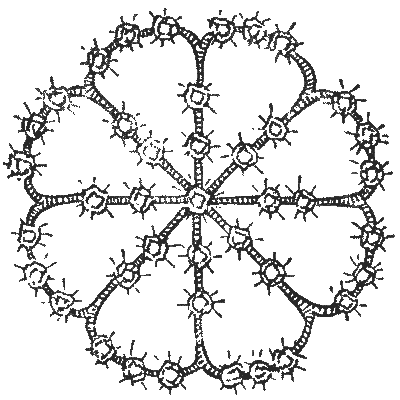
Six months later a brother of Lady Littlewood's, who had returned from his regiment in India, noticed that his sister was wearing the ruby brooch one night at a county ball, and on their return home asked to look at it more closely. He immediately detected the fact that four of the stones were gone.
"How can that possibly be?" said Lady Littlewood. "If you count up one line from the centre, along the edge, and down the next line, in any direction, there are always eight stones. This was always so and is so now. How, therefore, would it be possible to remove a stone without my detecting it?"
"Nothing could be simpler," replied the brother. "I know the brooch well. It originally contained forty-five stones, and there are now only forty-one. Somebody has stolen four rubies, and then reset as small a number of the others as possible in such a way that there shall always be eight in any of the directions you have mentioned."
There was not the slightest doubt that the Brompton jeweller was the thief, and the matter was placed in the hands of the police. But the man was wanted for other robberies, and had left the neighbourhood some time before. To this day he has never been found.
The interesting little point that at first baffled the police, and which forms the subject of our puzzle, is this: How were the forty-five rubies originally arranged on the brooch? The illustration shows exactly how the forty-one were arranged after it came back from the jeweller; but although they count eight correctly in any of the directions mentioned, there are four stones missing.
Sources:- Amusements in Mathematics, Henry Ernest Dudeney Question 423
-
FIND THE MAN'S WIFE
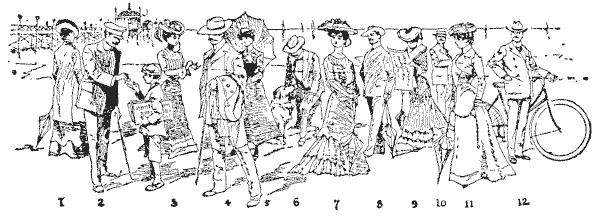
One summer day in `1903` I was loitering on the Brighton front, watching the people strolling about on the beach, when the friend who was with me suddenly drew my attention to an individual who was standing alone, and said, "Can you point out that man's wife? They are stopping at the same hotel as I am, and the lady is one of those in view." After a few minutes' observation, I was successful in indicating the lady correctly. My friend was curious to know by what method of reasoning I had arrived at the result. This was my answer:—
"We may at once exclude that Sister of Mercy and the girl in the short frock; also the woman selling oranges. It cannot be the lady in widows' weeds. It is not the lady in the bath chair, because she is not staying at your hotel, for I happened to see her come out of a private house this morning assisted by her maid. The two ladies in red breakfasted at my hotel this morning, and as they were not wearing outdoor dress I conclude they are staying there. It therefore rests between the lady in blue and the one with the green parasol. But the left hand that holds the parasol is, you see, ungloved and bears no wedding-ring. Consequently I am driven to the conclusion that the lady in blue is the man's wife—and you say this is correct."
Now, as my friend was an artist, and as I thought an amusing puzzle might be devised on the lines of his question, I asked him to make me a drawing according to some directions that I gave him, and I have pleasure in presenting his production to my readers. It will be seen that the picture shows six men and six ladies: Nos. `1, 3, 5, 7, 9`, and `11` are ladies, and Nos. `2, 4, 6, 8, 10`, and `12` are men. These twelve individuals represent six married couples, all strangers to one another, who, in walking aimlessly about, have got mixed up. But we are only concerned with the man that is wearing a straw hat—Number `10`. The puzzle is to find this man's wife. Examine the six ladies carefully, and see if you can determine which one of them it is.
I showed the picture at the time to a few friends, and they expressed very different opinions on the matter. One said, "I don't believe he would marry a girl like Number `7`." Another said, "I am sure a nice girl like Number `3` would not marry such a fellow!" Another said, "It must be Number `1`, because she has got as far away as possible from the brute!" It was suggested, again, that it must be Number `11`, because "he seems to be looking towards her;" but a cynic retorted, "For that very reason, if he is really looking at her, I should say that she is not his wife!"
I now leave the question in the hands of my readers. Which is really Number `10`'s wife?
The illustration is of necessity considerably reduced from the large scale on which it originally appeared in The Weekly Dispatch (24th May `1903`), but it is hoped that the details will be sufficiently clear to allow the reader to derive entertainment from its examination. In any case the solution given will enable him to follow the points with interest.
Sources:
- Amusements in Mathematics, Henry Ernest Dudeney Question 430
-
Question
Move one matchstick to make a valid equation.
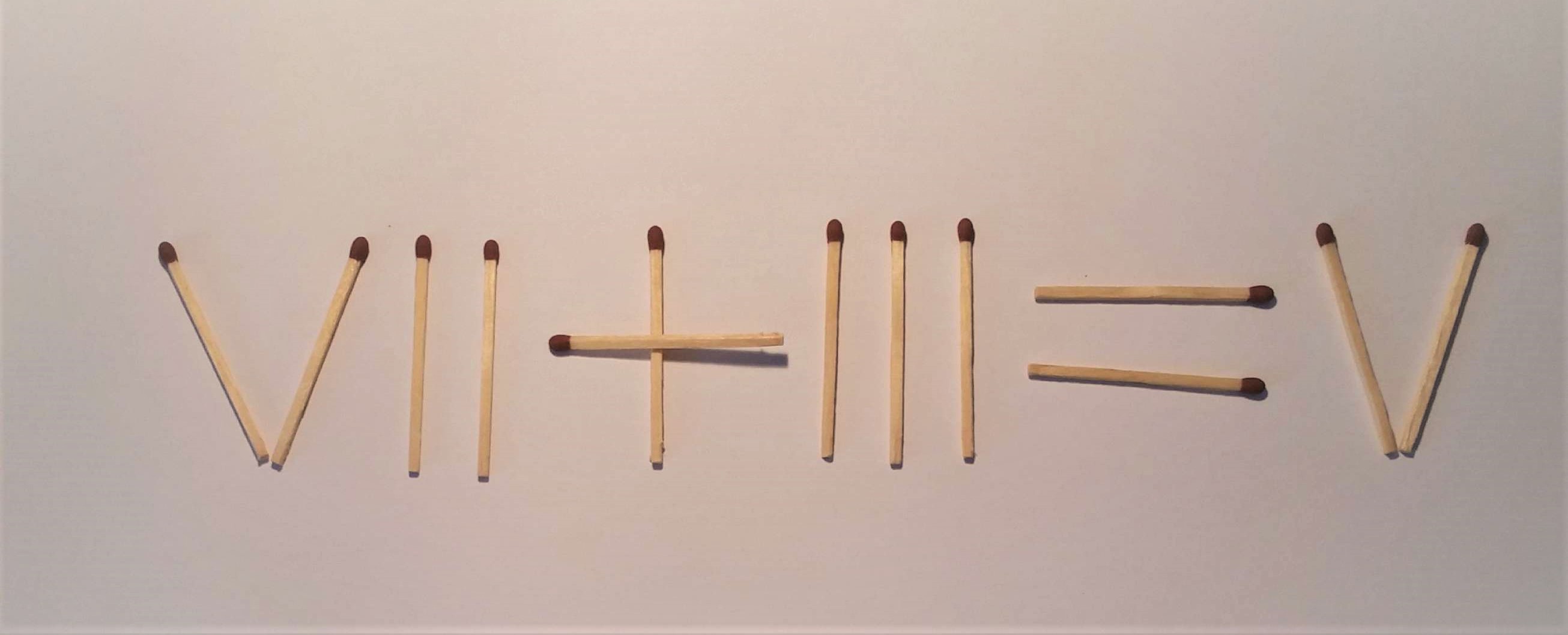
Note: There may be multiple solutions.
Sources:- Tournament of Towns, 1983-1984, Fall, Practice Version, Grades 9-10 Question 4 Points 8
-
The Matchstick Root
Move one matchstick to make a correct equality:
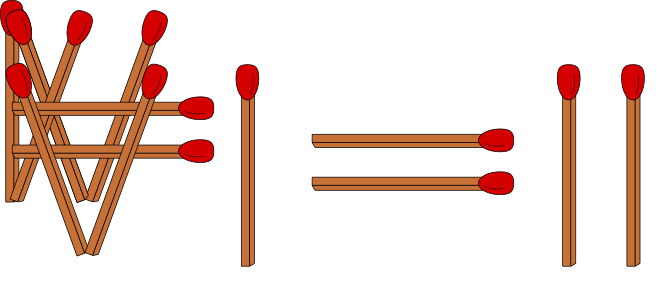 Topics:Algebra -> Algebraic Techniques -> Roots / Radicals Puzzles and Rebuses -> Matchstick Puzzles
 -
5 Squares
Move three matches to create 5 squares:
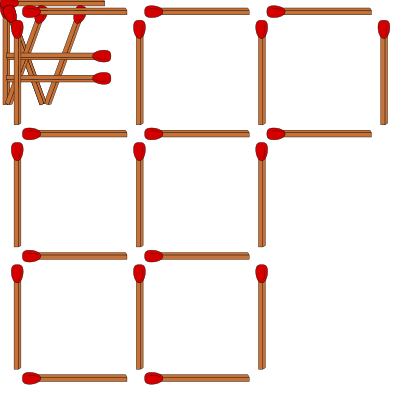 Topics:Puzzles and Rebuses -> Matchstick Puzzles
 -
8-5=7?
Remove two matchsticks to make the following equation true:
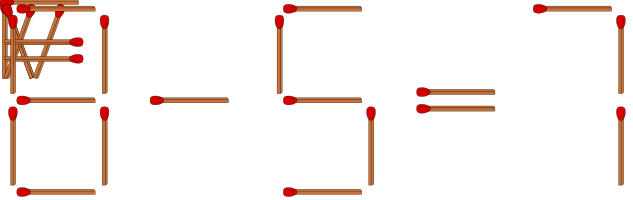 Sources:Topics:Puzzles and Rebuses -> Matchstick Puzzles
 -
Inverted Chair
The chair is upside down. You need to move two matchsticks to return it to its original position.
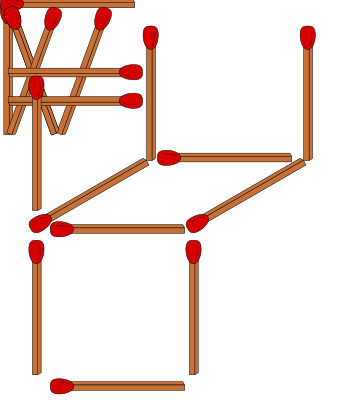 Topics:Puzzles and Rebuses -> Matchstick Puzzles
 -
Add 2, Get 4
Add 2 matchsticks to form exactly 4 squares:
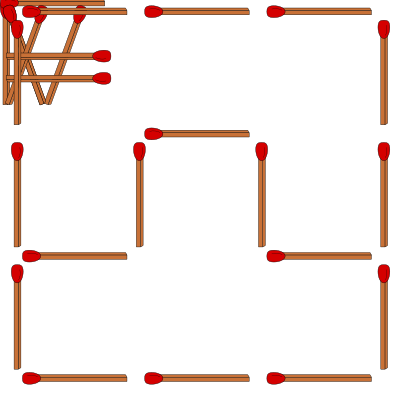 Topics:Puzzles and Rebuses -> Matchstick Puzzles
 -
A NEW MATCH PUZZLE
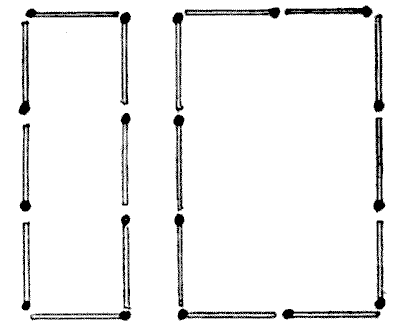 In the illustration eighteen matches are shown arranged so that they enclose two spaces, one just twice as large as the other. Can you rearrange them (`1`) so as to enclose two four-sided spaces, one exactly three times as large as the other, and (`2`) so as to enclose two five-sided spaces, one exactly three times as large as the other? All the eighteen matches must be fairly used in each case; the two spaces must be quite detached, and there must be no loose ends or duplicated matches.
Sources:Topics:Geometry -> Area Calculation Combinatorics -> Combinatorial Geometry -> Cut a Shape / Dissection Problems Puzzles and Rebuses -> Matchstick Puzzles
In the illustration eighteen matches are shown arranged so that they enclose two spaces, one just twice as large as the other. Can you rearrange them (`1`) so as to enclose two four-sided spaces, one exactly three times as large as the other, and (`2`) so as to enclose two five-sided spaces, one exactly three times as large as the other? All the eighteen matches must be fairly used in each case; the two spaces must be quite detached, and there must be no loose ends or duplicated matches.
Sources:Topics:Geometry -> Area Calculation Combinatorics -> Combinatorial Geometry -> Cut a Shape / Dissection Problems Puzzles and Rebuses -> Matchstick Puzzles- Amusements in Mathematics, Henry Ernest Dudeney Question 204
-
THE SIX SHEEP-PENS
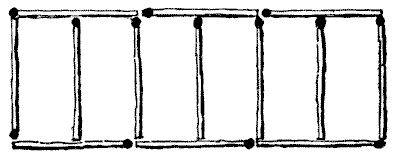
Here is a new little puzzle with matches. It will be seen in the illustration that thirteen matches, representing a farmer's hurdles, have been so placed that they enclose six sheep-pens all of the same size. Now, one of these hurdles was stolen, and the farmer wanted still to enclose six pens of equal size with the remaining twelve. How was he to do it? All the twelve matches must be fairly used, and there must be no duplicated matches or loose ends.
Sources:Topics:Puzzles and Rebuses -> Matchstick Puzzles- Amusements in Mathematics, Henry Ernest Dudeney Question 205