Number Theory
Number Theory is a branch of mathematics concerned with the properties of integers. Topics include prime numbers, divisibility, congruences (modular arithmetic), Diophantine equations, and functions of integers. Questions often require analytical and creative thinking about numbers.
Prime Numbers Chinese Remainder Theorem Modular Arithmetic / Remainder Arithmetic Greatest Common Divisor (GCD) and Least Common Multiple (LCM) Triangular Numbers Division-
Question
Is the following number prime?
`4^9 + 6^10 + 3^20`
-
Question
Prove that if `n!+1` is divisible by `n+1`, then `n+1` is prime.
-
Question
Does there exist an infinite arithmetic progression consisting only of prime numbers?
Note: We do not consider "trivial" arithmetic progressions, which are constant.
-
Question
Consider the integers from `1` to `700`.
a. How many of these numbers are even?
b. How many of these numbers are divisible by `7`?
c. How many of these numbers are not divisible by `2` nor by `7`?
Answer question c.
-
Question
Given `50` distinct natural numbers between `1` and `100`. It is known that no two of these numbers sum to `100`. Is it necessarily true that one of these numbers must be a perfect square?
Topics:Number Theory -> Prime Numbers Arithmetic Combinatorics -> Pigeonhole Principle Combinatorics -> Matchings Logic -> Reasoning / Logic Proof and Example -> Constructing an Example / Counterexample Set Theory Combinatorics -> Case Analysis / Checking Cases -> Processes / Procedures Proof and Example -> Proof by Contradiction -
Question
Is there a solution in natural numbers to the equation `x^2 + 12 = y^3` such that
a. x is even (easier)
b. x is odd
Sources: -
Letter Replacement
Each letter represents a different digit; whenever a specific letter appears, it is necessarily the same digit.
Find `B-E/2`
Given: `AB*C=DE`
And also `F^D=GF`
-
The Number
Given a positive integer less than 2000.
If it is not divisible by 43, then it is divisible by 41,
If it is not divisible by 53, then it is divisible by 43,
If it is not divisible by 41, then it is divisible by 53.
Find the number.Sources:Topics:Number Theory -> Prime Numbers Arithmetic Number Theory -> Modular Arithmetic / Remainder Arithmetic -> Divisibility Rules Logic -> Reasoning / Logic Number Theory -> Greatest Common Divisor (GCD) and Least Common Multiple (LCM) Combinatorics -> Case Analysis / Checking Cases -> Processes / Procedures Number Theory -> Division -
THE BANKER'S PUZZLE
A banker had a sporting customer who was always anxious to wager on anything. Hoping to cure him of his bad habit, he proposed as a wager that the customer would not be able to divide up the contents of a box containing only sixpences into an exact number of equal piles of sixpences. The banker was first to put in one or more sixpences (as many as he liked); then the customer was to put in one or more (but in his case not more than a pound in value), neither knowing what the other put in. Lastly, the customer was to transfer from the banker's counter to the box as many sixpences as the banker desired him to put in. The puzzle is to find how many sixpences the banker should first put in and how many he should ask the customer to transfer, so that he may have the best chance of winning.Sources:Topics:Number Theory -> Prime Numbers Number Theory -> Modular Arithmetic / Remainder Arithmetic -> Euler's Theorem and Fermat's Little Theorem- Amusements in Mathematics, Henry Ernest Dudeney Question 134
-
THE DUTCHMEN'S WIVES
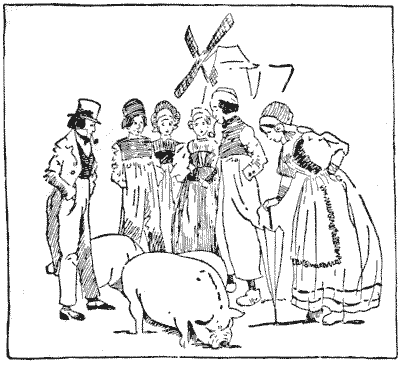
I wonder how many of my readers are acquainted with the puzzle of the "Dutchmen's Wives"—in which you have to determine the names of three men's wives, or, rather, which wife belongs to each husband. Some thirty years ago it was "going the rounds," as something quite new, but I recently discovered it in the Ladies' Diary for `1739-40`, so it was clearly familiar to the fair sex over one hundred and seventy years ago. How many of our mothers, wives, sisters, daughters, and aunts could solve the puzzle to-day? A far greater proportion than then, let us hope.
Three Dutchmen, named Hendrick, Elas, and Cornelius, and their wives, Gurtrün, Katrün, and Anna, purchase hogs. Each buys as many as he (or she) gives shillings for one. Each husband pays altogether three guineas more than his wife. Hendrick buys twenty-three more hogs than Katrün, and Elas eleven more than Gurtrün. Now, what was the name of each man's wife?
 Sources:Topics:Number Theory -> Prime Numbers Arithmetic Algebra -> Word Problems Algebra -> Equations -> Diophantine Equations
- Amusements in Mathematics, Henry Ernest Dudeney Question 139