Combinatorics
Combinatorics is the art of counting. It deals with selections, arrangements, and combinations of objects. Questions involve determining the number of ways to perform tasks, arrange items (permutations), or choose subsets (combinations), often using principles like the product rule and sum rule.
Pigeonhole Principle Double Counting Binomial Coefficients and Pascal's Triangle Product Rule / Rule of Product Graph Theory Matchings Induction (Mathematical Induction) Game Theory Combinatorial Geometry Invariants Case Analysis / Checking Cases Processes / Procedures Number Tables Colorings-
Palindromic Number
Find a four-digit palindromic number that is divisible by 25 and not divisible by 3.
Note: A palindromic number is a number that does not change if its digits are read in reverse order. For example, the number 5775 is a palindromic number, and the number 5778 is not a palindromic number.
Sources:Topics:Number Theory -> Modular Arithmetic / Remainder Arithmetic -> Divisibility Rules -> Divisibility Rules by 3 and 9 Number Theory -> Division -> Parity (Even/Odd) Number Theory -> Modular Arithmetic / Remainder Arithmetic -> Divisibility Rules -> Divisibility Rules by 5 and 25 Combinatorics -> Case Analysis / Checking Cases -> Processes / Procedures -
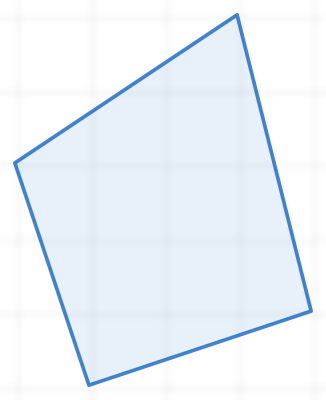
Area of the Shape
Given a grid paper where the area of each square is one unit area. Find the area of the shape (in unit areas)
 Sources:
 -
Differences in the Multiplication Table
Color the `10xx10` multiplication table with a black and white chessboard coloring, such that the cell of `1xx1` is colored black.
Find the difference between the sum of all the numbers in the black cells and the sum of all the numbers in the white cells.
1 2 3 4 5 6 7 8 9 10 1 1 2 3 4 5 6 7 8 9 10 2 2 4 6 8 10 12 14 16 18 20 3 3 6 9 12 15 18 21 24 27 30 4 4 8 12 16 20 24 28 32 36 40 5 5 10 15 20 25 30 35 40 45 50 6 6 12 18 24 30 36 42 48 54 60 7 7 14 21 28 35 42 49 56 63 70 8 8 16 24 32 40 48 56 64 72 80 9 9 18 27 36 45 54 63 72 81 90 10 10 20 30 40 50 60 70 80 90 100 Sources: -
Question
The plane is divided by n lines and circles.
Prove that the resulting map can be colored with two colors such that any two adjacent regions (separated by a segment or an arc) are colored with different colors.
Sources: -
Question
Inside a square with side length 1, `n>=101` points are marked, such that no three are collinear. A triangle is called marked if its vertices are marked points. Prove that the area of one of the marked triangles is less than `1/100`
Sources: -
Question
Given a regular polygon with n vertices. Calculate the number of distinct (non-congruent) triangles whose vertices coincide with the vertices of the polygon.
Sources: -
Question
Given an infinite grid whose vertices are colored with two colors, blue and red. Prove that there exist two horizontal lines and two vertical lines such that their four intersection points are colored with the same color.
Sources:Topics:Combinatorics -> Pigeonhole Principle Combinatorics -> Combinatorial Geometry Geometry -> Plane Geometry Combinatorics -> Colorings- Zebra Exercises, 2018-2019, Exercise 1 Question 1
-
What is in each container?
On the table, a cup, glass, pitcher, and jar are arranged in a row in an unknown order. The containers hold milk, orange juice, cola, and water, but it is unknown which liquid is in each container. Given that:
- The milk and water are not in the cup.
- The container holding orange juice is between the pitcher and the container holding cola.
- The jar does not contain water or orange juice.
- The glass is between the jar and the container with the milk.
Which liquid is in which container?
-
Question
Grandma Hannah has many flowerpots with flowers in her house. One day, her three grandchildren, Avi, Beni, and Gili, came to visit and tried to guess how many flowerpots she has.
Sources:
Avi said: "Grandma has more than 8 flowerpots,"
Beni said: "More than 10, I think,"
And then Gili said: "Grandma Hannah has at least 12 flowerpots."
"Two of you are right, and one of you is wrong," answered the grandmother. So how many flowerpots does she have in the house? -
Toys
Jonathan has a collection of wooden toys. Some are cubes and some are spheres, some are red and some are blue.
It is known that there are more spheres than cubes, and it is known that there are more blue toys than red toys.
Prove that Jonathan has a blue sphere.
Sources: