Combinatorics, Combinatorial Geometry
Combinatorial Geometry explores the connections between combinatorics and geometry. It deals with problems about arrangements, configurations, and properties of discrete geometric objects (points, lines, polygons). Questions often involve counting, existence proofs, and geometric inequalities.
Cut a Shape / Dissection Problems Grid Paper Geometry / Lattice Geometry-
ANOTHER PATCHWORK PUZZLE
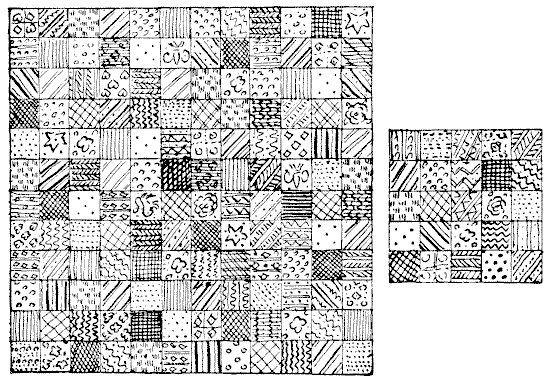 A lady was presented, by two of her girl friends, with the pretty pieces of silk patchwork shown in our illustration. It will be seen that both pieces are made up of squares all of the same size—one 12x12 and the other 5x5. She proposes to join them together and make one square patchwork quilt, 13x13, but, of course, she will not cut any of the material—merely cut the stitches where necessary and join together again. What perplexes her is this. A friend assures her that there need be no more than four pieces in all to join up for the new quilt. Could you show her how this little needlework puzzle is to be solved in so few pieces?
Sources:Topics:Geometry -> Plane Geometry Geometry -> Area Calculation Combinatorics -> Combinatorial Geometry -> Cut a Shape / Dissection Problems
A lady was presented, by two of her girl friends, with the pretty pieces of silk patchwork shown in our illustration. It will be seen that both pieces are made up of squares all of the same size—one 12x12 and the other 5x5. She proposes to join them together and make one square patchwork quilt, 13x13, but, of course, she will not cut any of the material—merely cut the stitches where necessary and join together again. What perplexes her is this. A friend assures her that there need be no more than four pieces in all to join up for the new quilt. Could you show her how this little needlework puzzle is to be solved in so few pieces?
Sources:Topics:Geometry -> Plane Geometry Geometry -> Area Calculation Combinatorics -> Combinatorial Geometry -> Cut a Shape / Dissection Problems- Amusements in Mathematics, Henry Ernest Dudeney Question 175
-
LINOLEUM CUTTING
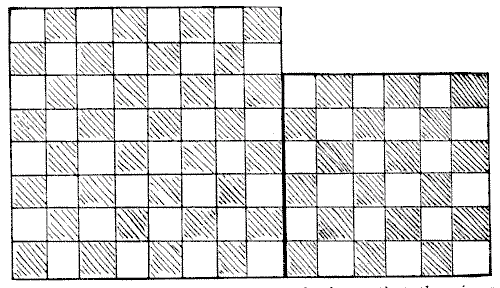 The diagram herewith represents two separate pieces of linoleum. The chequered pattern is not repeated at the back, so that the pieces cannot be turned over. The puzzle is to cut the two squares into four pieces so that they shall fit together and form one perfect square `10`×`10`, so that the pattern shall properly match, and so that the larger piece shall have as small a portion as possible cut from it.
Sources:Topics:Geometry -> Area Calculation Geometry -> Plane Geometry -> Pythagorean Theorem Combinatorics -> Combinatorial Geometry -> Cut a Shape / Dissection Problems
The diagram herewith represents two separate pieces of linoleum. The chequered pattern is not repeated at the back, so that the pieces cannot be turned over. The puzzle is to cut the two squares into four pieces so that they shall fit together and form one perfect square `10`×`10`, so that the pattern shall properly match, and so that the larger piece shall have as small a portion as possible cut from it.
Sources:Topics:Geometry -> Area Calculation Geometry -> Plane Geometry -> Pythagorean Theorem Combinatorics -> Combinatorial Geometry -> Cut a Shape / Dissection Problems- Amusements in Mathematics, Henry Ernest Dudeney Question 176
-
ANOTHER LINOLEUM PUZZLE
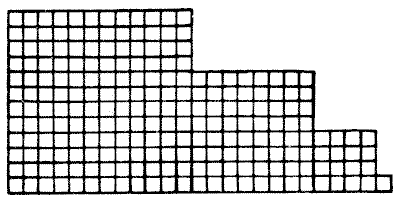
Can you cut this piece of linoleum into four pieces that will fit together and form a perfect square? Of course the cuts may only be made along the lines.
Sources:Topics:Geometry -> Plane Geometry Combinatorics -> Combinatorial Geometry -> Cut a Shape / Dissection Problems- Amusements in Mathematics, Henry Ernest Dudeney Question 177
-
THE FOUR SONS
Readers will recognize the diagram as a familiar friend of their youth. A man possessed a square-shaped estate. He bequeathed to his widow the quarter of it that is shaded off. The remainder was to be divided equitably amongst his four sons, so that each should receive land of exactly the same area and exactly similar in shape. We are shown how this was done. But the remainder of the story is not so generally known. In the centre of the estate was a well, indicated by the dark spot, and Benjamin, Charles, and David complained that the division was not "equitable," since Alfred had access to this well, while they could not reach it without trespassing on somebody else's land. The puzzle is to show how the estate is to be apportioned so that each son shall have land of the same shape and area, and each have access to the well without going off his own land.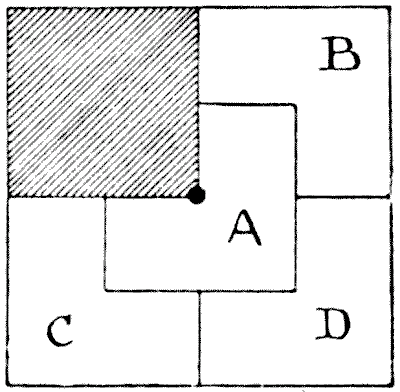 Sources:Topics:Geometry -> Plane Geometry Geometry -> Area Calculation Combinatorics -> Combinatorial Geometry -> Cut a Shape / Dissection Problems
- Amusements in Mathematics, Henry Ernest Dudeney Question 180
-
THE GARDEN WALLS
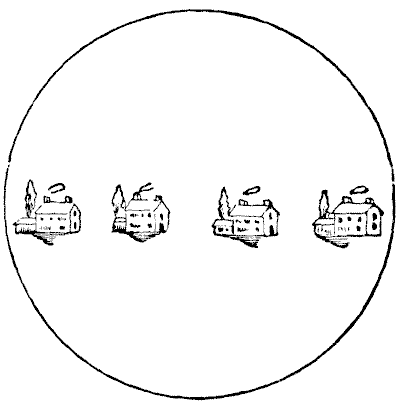
A speculative country builder has a circular field, on which he has erected four cottages, as shown in the illustration. The field is surrounded by a brick wall, and the owner undertook to put up three other brick walls, so that the neighbours should not be overlooked by each other, but the four tenants insist that there shall be no favouritism, and that each shall have exactly the same length of wall space for his wall fruit trees. The puzzle is to show how the three walls may be built so that each tenant shall have the same area of ground, and precisely the same length of wall.
Of course, each garden must be entirely enclosed by its walls, and it must be possible to prove that each garden has exactly the same length of wall. If the puzzle is properly solved no figures are necessary.
Sources:Topics:Geometry -> Area Calculation Geometry -> Plane Geometry -> Circles Combinatorics -> Combinatorial Geometry -> Cut a Shape / Dissection Problems- Amusements in Mathematics, Henry Ernest Dudeney Question 194
-
A NEW MATCH PUZZLE
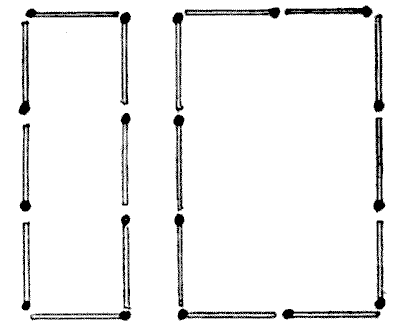 In the illustration eighteen matches are shown arranged so that they enclose two spaces, one just twice as large as the other. Can you rearrange them (`1`) so as to enclose two four-sided spaces, one exactly three times as large as the other, and (`2`) so as to enclose two five-sided spaces, one exactly three times as large as the other? All the eighteen matches must be fairly used in each case; the two spaces must be quite detached, and there must be no loose ends or duplicated matches.
Sources:Topics:Geometry -> Area Calculation Combinatorics -> Combinatorial Geometry -> Cut a Shape / Dissection Problems Puzzles and Rebuses -> Matchstick Puzzles
In the illustration eighteen matches are shown arranged so that they enclose two spaces, one just twice as large as the other. Can you rearrange them (`1`) so as to enclose two four-sided spaces, one exactly three times as large as the other, and (`2`) so as to enclose two five-sided spaces, one exactly three times as large as the other? All the eighteen matches must be fairly used in each case; the two spaces must be quite detached, and there must be no loose ends or duplicated matches.
Sources:Topics:Geometry -> Area Calculation Combinatorics -> Combinatorial Geometry -> Cut a Shape / Dissection Problems Puzzles and Rebuses -> Matchstick Puzzles- Amusements in Mathematics, Henry Ernest Dudeney Question 204
-
THE BURMESE PLANTATION
A short time ago I received an interesting communication from the British chaplain at Meiktila, Upper Burma, in which my correspondent informed me that he had found some amusement on board ship on his way out in trying to solve this little poser.
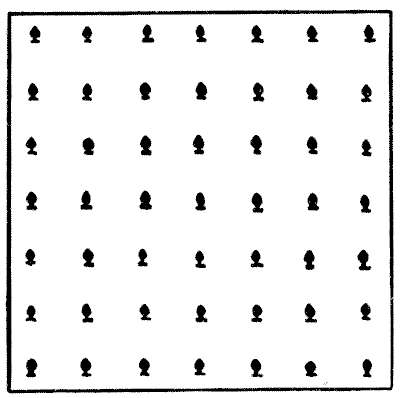
If he has a plantation of forty-nine trees, planted in the form of a square as shown in the accompanying illustration, he wishes to know how he may cut down twenty-seven of the trees so that the twenty-two left standing shall form as many rows as possible with four trees in every row.
Of course there may not be more than four trees in any row.
Sources:Topics:Combinatorics -> Case Analysis / Checking Cases -> Processes / Procedures Combinatorics -> Combinatorial Geometry -> Cut a Shape / Dissection Problems- Amusements in Mathematics, Henry Ernest Dudeney Question 212
-
CHEQUERED BOARD DIVISIONS
I recently asked myself the question: In how many different ways may a chessboard be divided into two parts of the same size and shape by cuts along the lines dividing the squares? The problem soon proved to be both fascinating and bristling with difficulties. I present it in a simplified form, taking a board of smaller dimensions.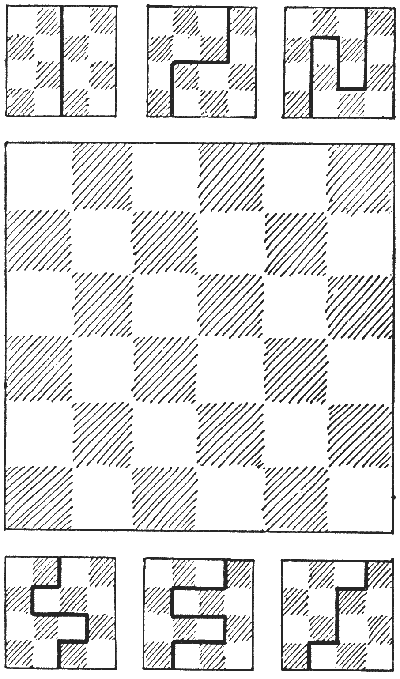 It is obvious that a board of four squares can only be so divided in one way—by a straight cut down the centre—because we shall not count reversals and reflections as different. In the case of a board of sixteen squares—four by four—there are just six different ways. I have given all these in the diagram, and the reader will not find any others. Now, take the larger board of thirty-six squares, and try to discover in how many ways it may be cut into two parts of the same size and shape.
Sources:Topics:Combinatorics -> Case Analysis / Checking Cases -> Processes / Procedures Combinatorics -> Combinatorial Geometry -> Cut a Shape / Dissection Problems
It is obvious that a board of four squares can only be so divided in one way—by a straight cut down the centre—because we shall not count reversals and reflections as different. In the case of a board of sixteen squares—four by four—there are just six different ways. I have given all these in the diagram, and the reader will not find any others. Now, take the larger board of thirty-six squares, and try to discover in how many ways it may be cut into two parts of the same size and shape.
Sources:Topics:Combinatorics -> Case Analysis / Checking Cases -> Processes / Procedures Combinatorics -> Combinatorial Geometry -> Cut a Shape / Dissection Problems- Amusements in Mathematics, Henry Ernest Dudeney Question 288
-
LIONS AND CROWNS
The young lady in the illustration is confronted with a little cutting-out difficulty in which the reader may be glad to assist her. She wishes, for some reason that she has not communicated to me, to cut that square piece of valuable material into four parts, all of exactly the same size and shape, but it is important that every piece shall contain a lion and a crown. As she insists that the cuts can only be made along the lines dividing the squares, she is considerably perplexed to find out how it is to be done. Can you show her the way? There is only one possible method of cutting the stuff.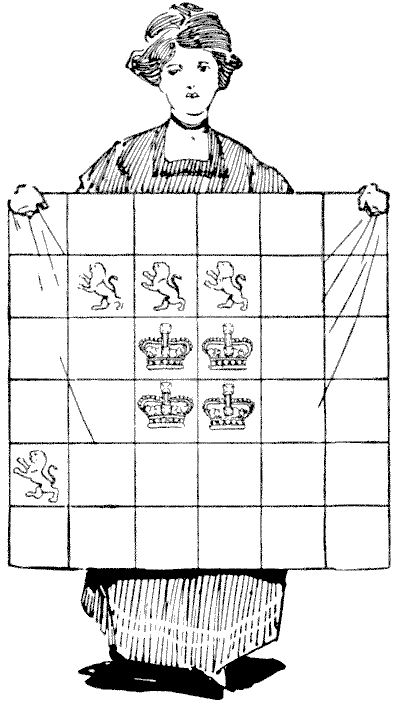 Sources:Topics:Combinatorics -> Combinatorial Geometry -> Cut a Shape / Dissection Problems Combinatorics -> Combinatorial Geometry -> Grid Paper Geometry / Lattice Geometry
- Amusements in Mathematics, Henry Ernest Dudeney Question 289
-
BOARDS WITH AN ODD NUMBER OF SQUARES
We will here consider the question of those boards that contain an odd number of squares. We will suppose that the central square is first cut out, so as to leave an even number of squares for division. Now, it is obvious that a square three by three can only be divided in one way, as shown in Fig. `1`. It will be seen that the pieces A and B are of the same size and shape, and that any other way of cutting would only produce the same shaped pieces, so remember that these variations are not counted as different ways. The puzzle I propose is to cut the board five by five (Fig. `2`) into two pieces of the same size and shape in as many different ways as possible. I have shown in the illustration one way of doing it. How many different ways are there altogether? A piece which when turned over resembles another piece is not considered to be of a different shape.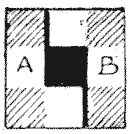
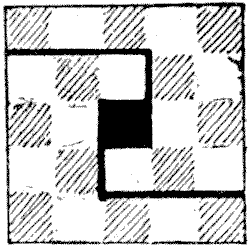 Sources:Topics:Geometry -> Plane Geometry -> Symmetry Combinatorics -> Combinatorial Geometry -> Cut a Shape / Dissection Problems Combinatorics -> Combinatorial Geometry -> Grid Paper Geometry / Lattice Geometry
- Amusements in Mathematics, Henry Ernest Dudeney Question 290