Combinatorics, Combinatorial Geometry
Combinatorial Geometry explores the connections between combinatorics and geometry. It deals with problems about arrangements, configurations, and properties of discrete geometric objects (points, lines, polygons). Questions often involve counting, existence proofs, and geometric inequalities.
Cut a Shape / Dissection Problems Grid Paper Geometry / Lattice Geometry-
Question
Cut the given shape into "T" shapes as shown in the diagram:
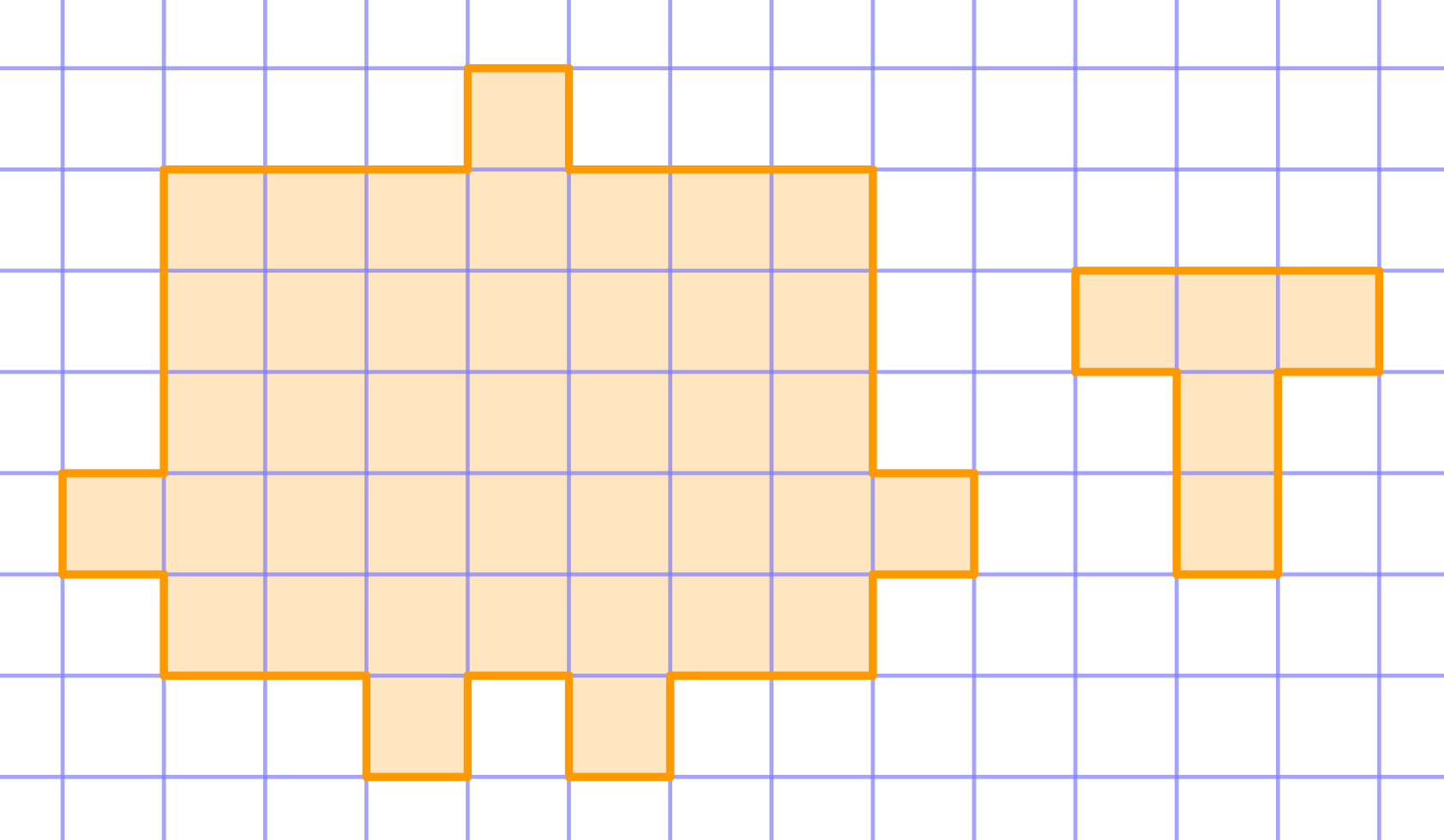
-
Question
Is there a quadrilateral that can be cut into `6` parts by two straight cuts? Justify your answer or provide an example.
-
Question
It is known that all the angles of the given shape are right angles. Cut the shape into two polygons of equal area. You are only allowed to use an unmarked ruler.
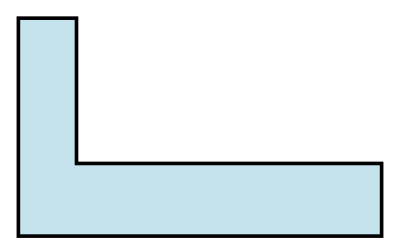
-
Question
Prove that the given shape cannot be cut into dominoes:

-
Question
Can you cut the shape on the left into six shapes like the shape on the right?
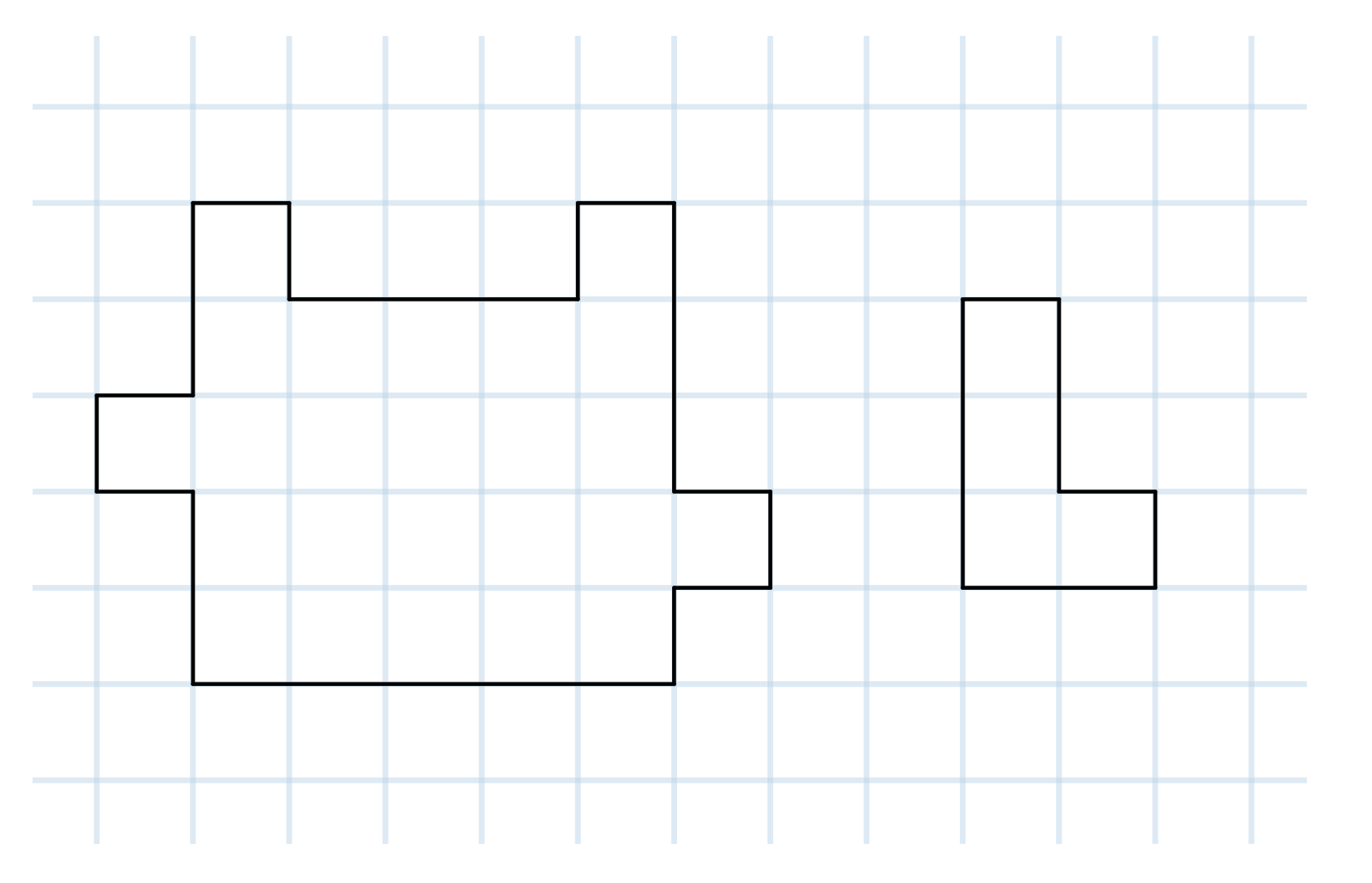
-
Area of the Shape
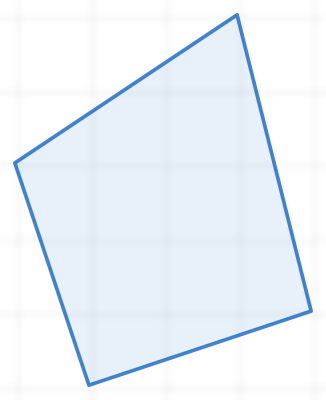
Given a grid paper where the area of each square is one unit area. Find the area of the shape (in unit areas)
 Sources:
 -
Cutting
What is the largest number of rectangles of size `2 times 5` that can be cut from a `9 times 9` square?
Sources: -
Squares
You have many cardboard squares of sizes `1 times 1`, `2 times 2`, and `3 times 3`, and you must assemble them into a square of size `7 times 7`.
Sources:
What is the smallest possible number of squares you will need? -
Dissect into four parts
Geometric shapes are called congruent if they coincide when superimposed. Cut the following shape into four congruent parts:
Sources: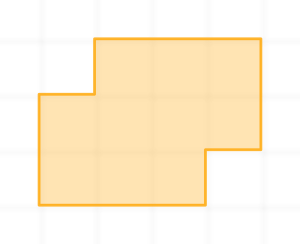
-
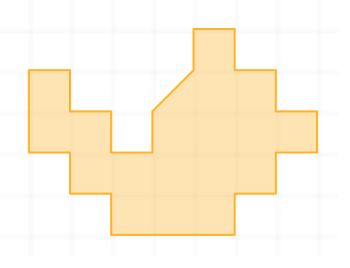
Cut a Boat in Half
Geometric shapes are called congruent if they coincide when placed on top of each other. Cut the shape into two congruent parts
 Sources:Topics:Geometry -> Plane Geometry -> Symmetry Combinatorics -> Combinatorial Geometry -> Cut a Shape / Dissection Problems