Geometry
Geometry is the branch of mathematics concerned with the properties and relations of points, lines, surfaces, solids, and higher dimensional analogues. Expected questions involve calculating lengths, angles, areas, and volumes of various shapes, understanding geometric theorems, and solving problems related to spatial reasoning.
Solid Geometry / Geometry in Space Trigonometry Spherical Geometry Plane Geometry Vectors-
Sum of Squares
Given a rectangle with an area of 13 and a perimeter of 20. On two adjacent sides of the rectangle, two squares are constructed, as shown in the figure. Find the sum of the areas of the squares.
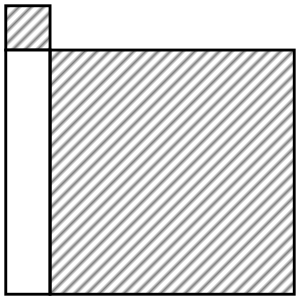 Sources:
 -
Difference of Square Areas
Two squares are given as depicted in the drawing. The side length of the larger square is 9,
the side length of the smaller square is 8. What is the difference between the area of the orange region and the area of the blue region?
Sources: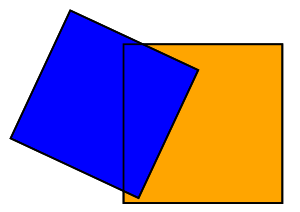
-
Orange Star of David
The area of the blue triangle is equal to 1. Calculate the area of the orange Star of David:
Sources: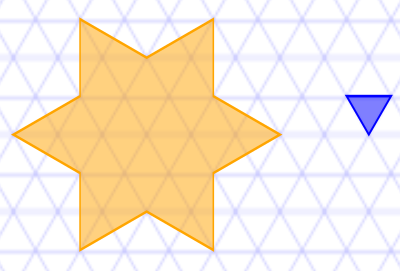
-
How Many Triangles - 2?
How many triangles are in the picture?
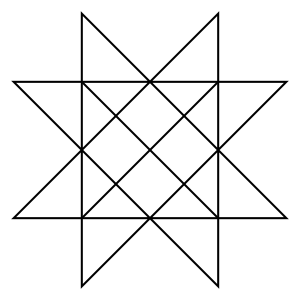 Sources:Topics:Geometry -> Area Calculation Geometry -> Plane Geometry -> Triangles Combinatorics -> Case Analysis / Checking Cases -> Processes / Procedures
 -
Largest Perimeter
A polygon with an area of 12 is drawn on grid paper, with all its sides passing through the grid lines. What is the largest possible perimeter of this polygon?
Sources: -
Area of the Shape
In the image, the area of the semicircle is equal to 1. Find the area of the larger shape, given that all the curved lines in the image are quarter circles.
Sources: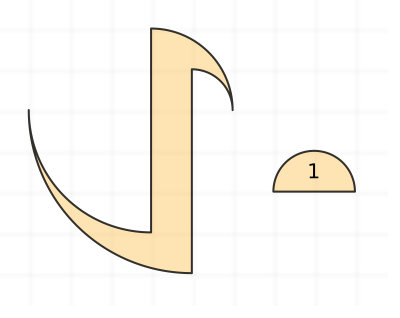
-
Enlarging a Rectangle
A rectangle is given in the plane. Is it possible that after each side of the rectangle is increased by 1 cm, the area increases by 1 square meter? Provide an example or prove that it is impossible.
(If the rectangle is 1x5, it becomes 2x6 and no side can be 0)
Sources:- Grossman Math Olympiad, 2017, Juniors Question 1
-
Question
Inside a square ABCD with side length 1, a point E is marked, and outside the square, a point F is marked, such that triangles ABE and DAF are equilateral. Calculate the area of the pentagon CBEFD.
 Sources:Topics:Geometry -> Area Calculation Geometry -> Plane Geometry -> Triangles Geometry -> Plane Geometry -> Symmetry Geometry -> Plane Geometry -> Plane Transformations -> Congruence Transformations (Isometries) -> Rotation
- Beno Arbel Olympiad, 2017, Grade 8 Question 6
-
REAPING THE CORN
A farmer had a square cornfield. The corn was all ripe for reaping, and, as he was short of men, it was arranged that he and his son should share the work between them. The farmer first cut one rod wide all round the square, thus leaving a smaller square of standing corn in the middle of the field. "Now," he said to his son, "I have cut my half of the field, and you can do your share." The son was not quite satisfied as to the proposed division of labour, and as the village schoolmaster happened to be passing, he appealed to that person to decide the matter. He found the farmer was quite correct, provided there was no dispute as to the size of the field, and on this point they were agreed. Can you tell the area of the field, as that ingenious schoolmaster succeeded in doing? Sources:- Amusements in Mathematics, Henry Ernest Dudeney Question 111
-
A FENCE PROBLEM
The practical usefulness of puzzles is a point that we are liable to overlook. Yet, as a matter of fact, I have from time to time received quite a large number of letters from individuals who have found that the mastering of some little principle upon which a puzzle was built has proved of considerable value to them in a most unexpected way. Indeed, it may be accepted as a good maxim that a puzzle is of little real value unless, as well as being amusing and perplexing, it conceals some instructive and possibly useful feature. It is, however, very curious how these little bits of acquired knowledge dovetail into the occasional requirements of everyday life, and equally curious to what strange and mysterious uses some of our readers seem to apply them. What, for example, can be the object of Mr. Wm. Oxley, who writes to me all the way from Iowa, in wishing to ascertain the dimensions of a field that he proposes to enclose, containing just as many acres as there shall be rails in the fence?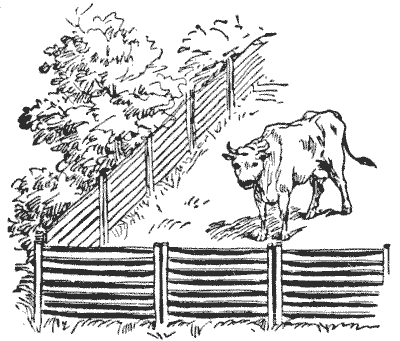 The man wishes to fence in a perfectly square field which is to contain just as many acres as there are rails in the required fence. Each hurdle, or portion of fence, is seven rails high, and two lengths would extend one pole (`16`½ ft.): that is to say, there are fourteen rails to the pole, lineal measure. Now, what must be the size of the field?
Sources:
The man wishes to fence in a perfectly square field which is to contain just as many acres as there are rails in the required fence. Each hurdle, or portion of fence, is seven rails high, and two lengths would extend one pole (`16`½ ft.): that is to say, there are fourteen rails to the pole, lineal measure. Now, what must be the size of the field?
Sources:
- Amusements in Mathematics, Henry Ernest Dudeney Question 117