Combinatorics
Combinatorics is the art of counting. It deals with selections, arrangements, and combinations of objects. Questions involve determining the number of ways to perform tasks, arrange items (permutations), or choose subsets (combinations), often using principles like the product rule and sum rule.
Pigeonhole Principle Double Counting Binomial Coefficients and Pascal's Triangle Product Rule / Rule of Product Graph Theory Matchings Induction (Mathematical Induction) Game Theory Combinatorial Geometry Invariants Case Analysis / Checking Cases Processes / Procedures Number Tables Colorings-
More Numbers with Ascending Digits
Miri writes down all the numbers whose decimal representation contains only the digits `1, 2, 3, 4, 5, 6`.
Sources:
(Not all digits must appear) and all the digits that appear are written in ascending order (e.g., 1356 or 124 or 5 but not 162 and not 1223).
How many numbers will Miri write down? -
The Round Table
Around a round table are 12 chairs, with knights sitting on some of them. Arthur wants to join the meeting,
Sources:
and it turns out that no matter where he sits, someone is definitely sitting next to him.
What is the smallest number of knights that can be around the table to ensure this is true? (not including Arthur) -
Two Hashes
What is the maximum number of "domino" shapes (rectangles `1 times 2` or `2 times 1`) that can be placed inside the orange shape,
such that they do not overlap and do not extend beyond the boundaries of the shape?
Sources: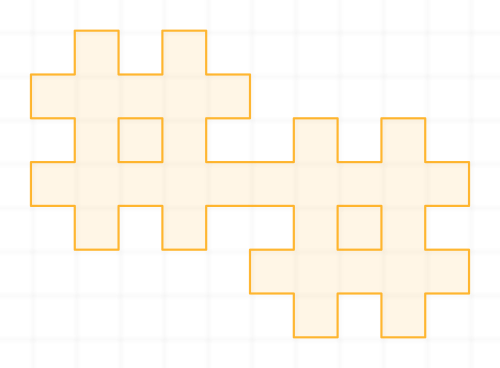
-
Domino Tiles
A domino tile is a rectangle composed of two squares, with each square marked with dots.
Sources:
The number of dots on each square can be from 0 to 6, and each pair of numbers appears exactly once (regardless of order).
In total, there are 28 tiles in the game. How many dots are there on these tiles in total? -
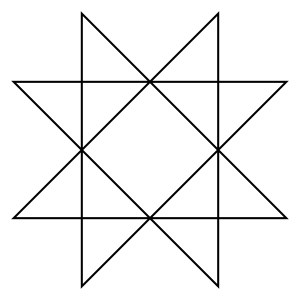
How many triangles?
How many triangles are there in the picture?
 Sources:Topics:Geometry -> Plane Geometry -> Triangles Combinatorics -> Case Analysis / Checking Cases -> Processes / Procedures Geometry -> Plane Geometry -> Angle Calculation Number Theory -> Division
 -
The Number
Given a positive integer less than 2000.
If it is not divisible by 43, then it is divisible by 41,
If it is not divisible by 53, then it is divisible by 43,
If it is not divisible by 41, then it is divisible by 53.
Find the number.Sources:Topics:Number Theory -> Prime Numbers Arithmetic Number Theory -> Modular Arithmetic / Remainder Arithmetic -> Divisibility Rules Logic -> Reasoning / Logic Number Theory -> Greatest Common Divisor (GCD) and Least Common Multiple (LCM) Combinatorics -> Case Analysis / Checking Cases -> Processes / Procedures Number Theory -> Division -
SLV LVS BLS
In the following expression, different letters represent different digits, and identical letters represent identical digits:
SLV = LVS + BLS
Find the number SLV.
Sources: -
Drawing Board
A painter has a `10 times 10` grid. Each time, the painter chooses a row or column and paints it entirely with a color of their choice.
Sources:
If they pass over a square that has already been painted with a new color, the new color completely covers the old color,
that is, the color of the square changes.
What is the largest number of colors we can see on this board? -
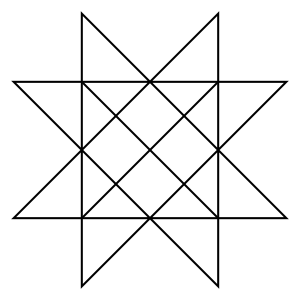
How Many Triangles - 2?
How many triangles are in the picture?
 Sources:Topics:Geometry -> Area Calculation Geometry -> Plane Geometry -> Triangles Combinatorics -> Case Analysis / Checking Cases -> Processes / Procedures
 -
5 Lines, 8 Intersections
Draw 5 lines such that there are exactly 8 points of intersection between them.
Sources: