Geometry, Plane Geometry
Plane Geometry concerns figures and shapes on a flat, two-dimensional surface. It covers properties of points, lines, angles, polygons (like triangles and quadrilaterals), and circles. Questions typically involve proofs, constructions, and calculations related to these elements.
Area Calculation Triangles Circles Symmetry Angle Calculation Pythagorean Theorem Triangle Inequality-
Orange Star of David
The area of the blue triangle is equal to 1. Calculate the area of the orange Star of David:
Sources: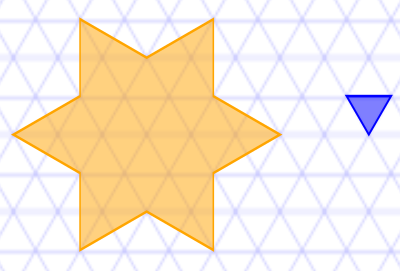
-
Angles
Calculate the sum of the marked angles:
Sources: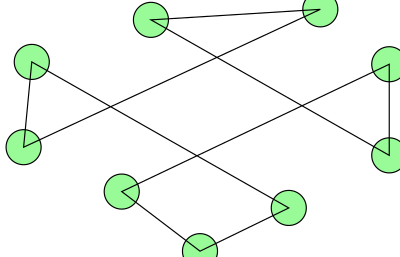
-
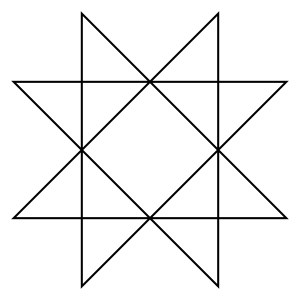
How many triangles?
How many triangles are there in the picture?
 Sources:Topics:Geometry -> Plane Geometry -> Triangles Combinatorics -> Case Analysis / Checking Cases -> Processes / Procedures Geometry -> Plane Geometry -> Angle Calculation Number Theory -> Division
 -
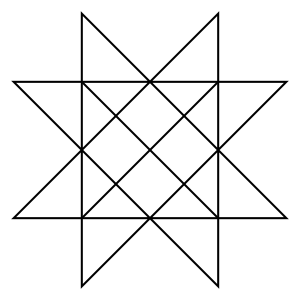
How Many Triangles - 2?
How many triangles are in the picture?
 Sources:Topics:Geometry -> Area Calculation Geometry -> Plane Geometry -> Triangles Combinatorics -> Case Analysis / Checking Cases -> Processes / Procedures
 -
Length of the Segment
On the side BC of triangle ABC, a point D is marked. The perimeter of triangle ABC is 15 centimeters, the perimeter of triangle ABD is 12 centimeters, and the perimeter of triangle ACD is 13 centimeters.
Sources:
What is the length of segment AD? -
Inscribed Circle in a Triangle
Inside a triangle there is a point P, whose distances from the lines containing the sides of the triangle are `d_a,d_b,d_c`. Let R denote the radius of the circumscribed circle of the triangle and r the radius of the inscribed circle in the triangle. Show that `sqrt(d_a)+sqrt(d_b)+sqrt(d_3)<= sqrt (2R+5r) `.
Sources:Topics:Geometry -> Plane Geometry -> Triangles Geometry -> Plane Geometry -> Circles Algebra -> Inequalities- Gillis Mathematical Olympiad, 2019-2020 Question 7
-
Triangle Side Lengths
Let `n > 2` be an integer, and let ` t_1,t_2,...,t_n` be positive real numbers such that
`(t_1+t_2+...+t_n)(1/t_1 + 1/t_2 + ... + 1/t_n) < n^2+1`
Prove that for all i,j,k such that `1<=i<j<k<=n`, the triple of numbers `t_i,t_j,t_k` are the side lengths of a triangle.
Sources:Topics:Geometry -> Plane Geometry -> Triangles Algebra -> Inequalities Proof and Example -> Proof by Contradiction Geometry -> Plane Geometry -> Triangle Inequality- Grossman Math Olympiad, 2006 Question 5
-
Paths in a Triangular Park
In a park, there are 3 straight paths that form a triangle (there are no additional paths). The entrances to the park are at the midpoints of the paths, and a lamp hangs at each vertex of the triangle. From each entrance, the shortest walking distance along the park's paths to the lamp at the opposite vertex was measured. It turned out that 2 out of the 3 distances are equal to each other. Is the triangle necessarily isosceles?
 Sources:Topics:Geometry -> Plane Geometry -> Triangles Proof and Example -> Constructing an Example / Counterexample Geometry -> Plane Geometry -> Triangle Inequality
- Beno Arbel Olympiad, 2017, Grade 8 Question 3
-
Question
Inside a square ABCD with side length 1, a point E is marked, and outside the square, a point F is marked, such that triangles ABE and DAF are equilateral. Calculate the area of the pentagon CBEFD.
 Sources:Topics:Geometry -> Area Calculation Geometry -> Plane Geometry -> Triangles Geometry -> Plane Geometry -> Symmetry Geometry -> Plane Geometry -> Plane Transformations -> Congruence Transformations (Isometries) -> Rotation
- Beno Arbel Olympiad, 2017, Grade 8 Question 6
-
THE THREE VILLAGES
I set out the other day to ride in a motor-car from Acrefield to Butterford, but by mistake I took the road going via Cheesebury, which is nearer Acrefield than Butterford, and is twelve miles to the left of the direct road I should have travelled. After arriving at Butterford I found that I had gone thirty-five miles. What are the three distances between these villages, each being a whole number of miles? I may mention that the three roads are quite straight.Sources:Topics:Geometry -> Plane Geometry -> Triangles Algebra -> Word Problems Geometry -> Plane Geometry -> Pythagorean Theorem- Amusements in Mathematics, Henry Ernest Dudeney Question 69