Geometry, Plane Geometry
Plane Geometry concerns figures and shapes on a flat, two-dimensional surface. It covers properties of points, lines, angles, polygons (like triangles and quadrilaterals), and circles. Questions typically involve proofs, constructions, and calculations related to these elements.
Area Calculation Triangles Circles Symmetry Angle Calculation Pythagorean Theorem Triangle Inequality-
Question
Is there a quadrilateral that can be cut into `6` parts by two straight cuts? Justify your answer or provide an example.
-
Area of the Shape
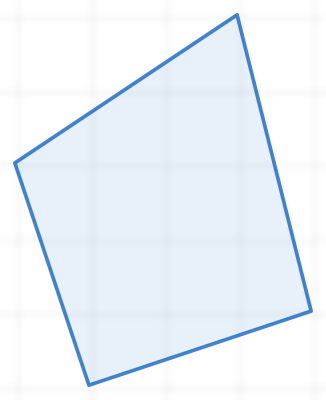
Given a grid paper where the area of each square is one unit area. Find the area of the shape (in unit areas)
 Sources:
 -
Question
The plane is divided by n lines and circles.
Prove that the resulting map can be colored with two colors such that any two adjacent regions (separated by a segment or an arc) are colored with different colors.
Sources: -
Question
Inside a square with side length 1, `n>=101` points are marked, such that no three are collinear. A triangle is called marked if its vertices are marked points. Prove that the area of one of the marked triangles is less than `1/100`
Sources: -
Question
Given an infinite grid whose vertices are colored with two colors, blue and red. Prove that there exist two horizontal lines and two vertical lines such that their four intersection points are colored with the same color.
Sources:Topics:Combinatorics -> Pigeonhole Principle Combinatorics -> Combinatorial Geometry Geometry -> Plane Geometry Combinatorics -> Colorings- Zebra Exercises, 2018-2019, Exercise 1 Question 1
-
Hexagon
In the diagram, there is a regular hexagon. By what factor is the area of the white region larger than the area of the shaded region?
(A regular hexagon is a hexagon where all sides are equal and all angles are equal.)
Sources: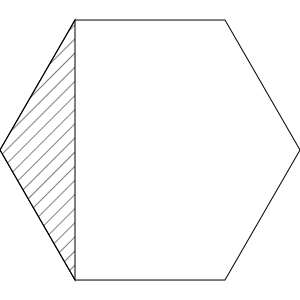
-
Products of Areas
In the figure, there is a rectangle and a point inside it. Two segments are drawn through the point, parallel to the sides of the rectangle, dividing the rectangle into 4 smaller rectangles.
Prove that the product of the areas of the shaded rectangles inside the rectangle is equal to the product of the areas of the unshaded rectangles inside the rectangle.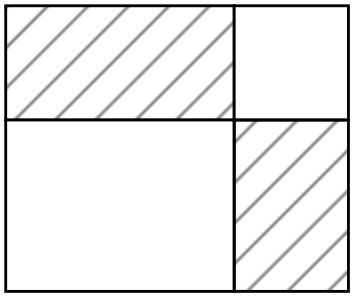 Sources:
 -
Puzzle
You have a puzzle where each piece looks like this:
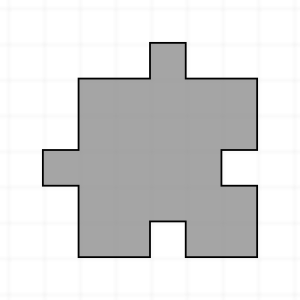
The following shape is made up of 12 pieces. What is its perimeter?
Sources: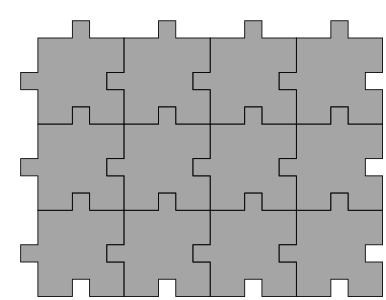
-
Another Gray Area
In the figure, a rectangle of size `3 times 5` and a line that crosses it diagonally. Find the shaded area.
Sources: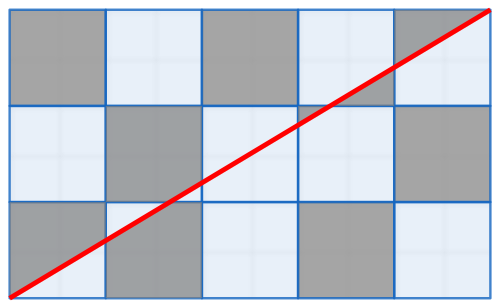
-
The Parallelogram
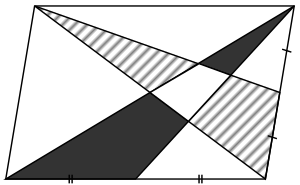
In the drawing, there is a parallelogram with its diagonals drawn and the midpoints of two of its sides connected to opposite vertices.
Which area is larger: the shaded or the striped?
Sources: